Monday, March 22, 2021

Cialdini's Social Proof (Age 8)

 I want to teach Benny about "social proof" in Robert Cialdini's Influence: The Psychology of Persuasion.


Social proof is basically "monkey see, monkey do".  But I wanted to show this in a form that a child can understand.


So I showed him these videos:


https://www.youtube.com/watch?v=P00i7_C8tl8


https://www.youtube.com/watch?v=TYIh4MkcfJA


https://www.youtube.com/watch?v=MEhSk71gUCQ  

Monday, October 21, 2019

Coding Functions (age 6)

Benny has been playing coding games where he was using very simple functions.

"Benny I use functions on my computer too! Come see!"

def my_function():
    print("hi Benny")

"This is my function. It says "Hi Benny". It's like the functions in your game. What do you think is going to happen if I call the function?"

def my_function():
    print("hi Benny")

my_function()

Benny laughs.

"What do you think is going to happen if I call the function five times?"

def my_function():
    print("hi Benny")

my_function()
my_function()
my_function()
my_function()
my_function()

Benny laughs loud.

"Why don't I change the name of my function to "say_hi_to_Benny"?"

def say_hi_to_Benny():
    print("hi Benny")

say_hi_to_Benny()
say_hi_to_Benny()
say_hi_to_Benny()
say_hi_to_Benny()
say_hi_to_Benny()

Benny laughs less loud.

"What if I make a function that calls the other function five times? What do you think's going to happen?"

def say_hi_to_Benny():
    print("hi Benny")

def say_hi_to_Benny_5_times():
    say_hi_to_Benny()
    say_hi_to_Benny()
    say_hi_to_Benny()
    say_hi_to_Benny()
    say_hi_to_Benny()

"Nothing happened! Because I didn't call the function. What do you think's going to happen if I call the function?"

def say_hi_to_Benny():
    print("hi Benny")

def say_hi_to_Benny_5_times():
    say_hi_to_Benny()
    say_hi_to_Benny()
    say_hi_to_Benny()
    say_hi_to_Benny()
    say_hi_to_Benny()


say_hi_to_Benny_5_times()

Benny laughs but I can tell he's losing interest so we stop there.

Monday, October 14, 2019

Why the Store Sells Us Apples (age 6)


"We give money to the store for apples.

The store gives some of that money to the store.

If the store gets $2 for the apples, and they give the farm $1, how much money did they make?  How much do they keep?"

"One dollar!"


"That money is called profit.  Profit is the money the store made.

If the store doesn't make any money, they won't sell us apples anymore because they won't have money to buy apples from the farm. They'll shut down."

"What will they do if they shut down?"

"They'll find out how to make money doing something else.

Do you know why the farm sells apples to the store?"

"So they can get money."


Monday, December 31, 2018

Math practice (age 5)

I put this on Benny's wall and when he's bored, he answers a few...
... until he finishes.

Now I'm switching on adding 6 through 10, and then will move to subtraction after that.


It helps that he now has a Google Home Mini that he can ask for help.

Sunday, December 23, 2018

Line Graphs (age 5)


While Benny was working on his goal of saving money for costumes, I decided that we should take the opportunity to teach Benny about line charts.


Saturday, December 1, 2018

Making An Animation (Age 5)

I'm trying to teach Benny that the world is malleable.  That he can change things.  He doesn't have to just observe or consume.  He can create.

He likes to watch Pencilmation on YouTube.  So we made our own (with pencil, paper, a phone camera and Google Photos):


Then I let Benny do more of the work:


Saving Money (Age 5)

I had previously introduced Benny to the concept of money.  Now I wanted him to learn to save money.

He asked for a Gecko costume in early October.  So I told him to save his money and he can buy it.   I told him how much he needed and helped him count his money to see his progress towards the goal.  Sometimes he got a little frustrated and anxious but he made it.


Not only did he get the Gecko costume, but he went on to buy more costumes.  Now (December 2018), he's working towards a Hatchimal.

Wednesday, October 24, 2018

Reading Practice: Treasure Hunt (Age 5)

Exercise:  I hide a cookie somewhere, then hide a hint describing where the cookie is, then hide a hint describing where that hint is, and so on.  I try to use some words he knows, some phonetic words, and some sight words he doesn't know.


Results: AWESOME!  Benny loves the game more than the cookie.  And he's picking up words quickly and voluntarily making a lot of effort to learn the words.

Sunday, October 7, 2018

Putting a Video on YouTube (Age 5)

Exercise: We uploaded a couple videos to YouTube (unlisted, by link only) and then he viewed them in the YouTube app on my mom's tablet.


I want to plant the idea in Benny's mind (many times in many ways) that the world is malleable - that he can change things and contribute.


Results:  So-so.  Benny thought it was funny to see himself on YouTube.  But he lost interest quickly.  It's hard to tell if it will make a lasting impact on him.

Addition and Subtraction (age 5)

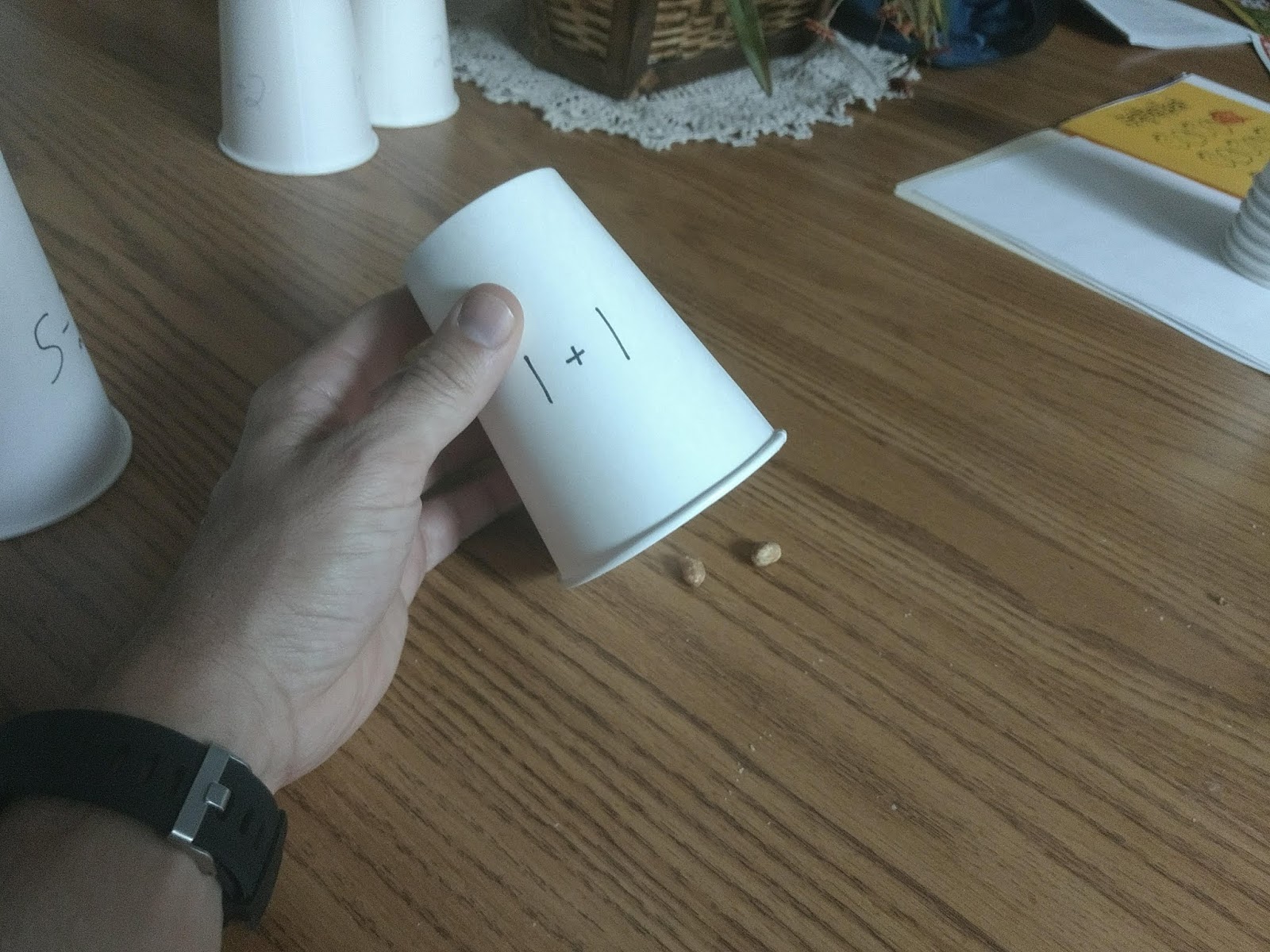
Exercise: I wrote addition and subtraction expressions using small numbers on cups and hid the same number of peanuts of fruit snacks underneath each cup.  Benny gets to eat the contents if he can guess the right number.  I started off with very simple addition (e.g. 1+1, 1+0) then moved to more difficult addition (e.g. 2+2, 3+2) and then to simple subtraction (1-0, 2-1) and then to more difficult subtraction (e.g. 5-3, 4-2).


Note: Benny had previously learned some addition through flash cards and a YouTube video.  He had also had some exposure to subtraction by "subtracting"/eating small food items.

Results: Awesome! Before he started kindergarten, Benny understood the concepts of addition and subtraction as well as the symbols for both.  Using his fingers, he is able to add two small numbers (< 5) and to subtract 0 and 1 from small numbers successfully.  He still struggles with larger numbers.


Sunday, August 19, 2018

Cosmic Scale: Sun, Earth, Moon (age 5)

Exercise:

I made a scaled model of the sun, the moon, and the Earth.

The goal is to create some curiosity to make learning easier later.  The size of the sun (1.3 million Earths) and the distance to the sun (91 million miles) is really mind-boggling and should create a strong impression.

Benny and his cousins moved the "sun" (a 4-foot beach ball) out to the scaled distance from the Earth (a 1-cm painted ball) in order to demonstrate just how big the sun is and how far away it is.

The sun was white (because the sun is white from space), the Earth was mostly blue (because most of the Earth's surface is Ocean).  I also emphasized that gravity makes the moon go around the Earth and the Earth go around the sun.


Results:

Good. Benny and his cousins seemed to enjoy it, especially playing with the sun. It's hard to tell how much an impression it made on the kids. The adults spent the evening talking about science so at least it made an impression on them.

Monday, July 16, 2018

Time (age 5)

Exercise:  Benny asked what time travel is (after watching a cartoon).  I then tried to explain to him what time is, using three things he cares about: dinosaurs, himself, and how old he is.  "In the past, you were a baby.  Now you're five.  In the future, you'll be ten.  In the past you were a baby.  Far in the past, there were dinosaurs."


Results:  Not sure.  At the time, he looked at the picture for a while and then went back to his cartoon.  But later, he asked if in the past, he was a baby in his mom's tummy.

Sunday, July 15, 2018

Waterford Institute Upstart program (year before kindergarten)

The Waterford Upstart program is web-based software that teaches kids to read.  The software feels clunky and old, but it does the job.  It's relatively complete.  Benny now can read a little bit and this program did more than half of the work

It was frustrating for the first month or two because Benny wasn't very interested in the first few activities.  But once he got used to it, it worked wonders when he was in the mood for it.

Anatomy Book

This book was pretty good.  Benny liked it, asked a lot of questions about what different things are.  Although I don't think he'll remember everything, I do think it was a good introduction.

http://a.co/4xtEMWB


Addition (age 5)


Exercise 1 (age 5): Benny surprisingly liked this addition video on YouTube.

Results: Benny memorized how to add 1 and 0 to small, one-digit numbers.  He also got exposed to the "+" and "=" signs.

Exercise 2 (age 4):  Flash cards with dots.


Results: Awesome.  Benny understood the concept immediately.  However, he still has to count the dots most of the time.

Zero (age 4)

Exercise 1 (age 4):  I put 2 peanuts in my hand.  I asked him how many peanuts there were.  Then I put 1 peanut in my hand and asked him how many.  Then I took and asked him how many.

Results: Great! He seemed a little confused at first.  I told him there were zero peanuts.  To reinforce the idea, I put 1 peanut in one hand and 0 in the other and told him "There is 1 peanut in this hand and 0 peanuts in this hand."  He seems to understand the concept of zero very well.

Number Square (age 5)

Exercise 1:  I printed a numbers square showing 1-100, but with several numbers missing.  The missing numbers were cut out and I told Benny to tape the missing numbers in place.


Results:  Somewhat good.  He knew which numbers were missing maybe 30% of the time.  He could get most of them with a little prompting.  He really liked this activity and asked to do it again.

Chores / Responsibility (age 5)

Exercise 1 (age 5):  I got Benny a calendar, ask him to clean his toys and give him a star after he does.

Results: Mixed.  I don't always remember to tell him to clean his toys.  And even when I do, he isn't always motivated by the stars.


Saturday, July 7, 2018

Sentences (ages 4-5)

Exercise 1 (ages 4-5):  I made sentences describing the location of cookies.  Benny likes cookies.  The idea here is to put in his mind the idea that reading has value.  Not to teach him that, but to make him really value reading.  These sentences had real value to him because if he read them, he could find his way to a cookie.   Note that the flash cards here are a progression over a month or two.  I started with "a cookie is on the bed" because Benny knew every word in that sentence.

Results:  Awesome! I had to point at each word and ask him what it was (and sometimes help him).  But after the first one, he was very eager.  I believe it was around that time that he started asking me what difference words and sentences say.

Exercise 2 (ages 4-5): Simple sentences.  I used flash cards of words that Benny knows in order to create simple sentences.  At first, I pointed to each word and asked him what it was.  Then I asked him to read the entire sentence.

Result: Awesome.  He was able to read some simple sentences, beyond just descriptions of where cookies are.

Bar Chart and Pictogram (age 5)

Exercise 1 (age 5):  I presented Benny with a pictogram.  The X axis had a picture of him, his mama, and myself.  the Y axis had numbers.  And the pictures were cookies (something Benny cares about).  I asked him how many cookies each person had.  I asked who had the most cookies.  Then I traced the number of cookies to the numbers on the Y axis.


Results: Great.  He got the idea.

Exercise 2 (age 5):  I presented Benny with a bar chart similar to the histogram, and with the same numbers and asked him similar questions.  Later, I added to the bars and asked him similar questions.


Results:  He needed a little more help than with the pictogram.  However, he learned to trace over to the left to figure out how many cookies each person had.  By the time I added more size to the bars, he knew how to answer the questions correctly with the new amounts.

Cialdini's Social Proof (Age 8)

 I want to teach Benny about "social proof" in Robert Cialdini's Influence: The Psychology of Persuasion . Social proof is bas...